

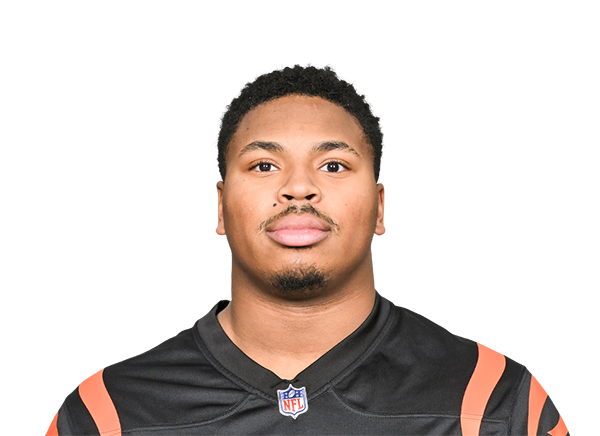
Kris Jenkins Jr.
DT · Cincinnati Bengals · #90
Complete NFL Player Profile
Early Life & Background
Kris Jenkins Jr. enters the NFL with a legacy of football excellence etched into his DNA, carrying forward the name of one of the most respected defensive tackles in league history, his father, Kris Jenkins Sr. Born and raised in Olney, Maryland, a suburb north of Washington, D.C., Jenkins Jr. was immersed in football culture from a young age. His father, a three-time Pro Bowler and two-time First-Team All-Pro during his 11-year NFL career with the Carolina Panthers and New Orleans Saints, was a physical specimen in his prime—standing 6'4", weighing 335 pounds, and known for his disruptive presence in the trenches. This familial backdrop provided Jenkins Jr. with both an aspirational goal and a practical blueprint for athletic achievement.
Growing up as the son of an NFL luminary came with unique pressures, but also unparalleled access to mentorship. From childhood, Jenkins Sr. emphasized the importance of discipline, technique, and football IQ. The Jenkins household in Olney was not just a home—it was a training ground where film study sessions, weight room routines, and positional coaching were as routine as family dinners. Kris Jenkins Jr. often spoke in interviews about the long walks from the living room to the backyard, where his father would simulate pass-rush moves and teach leverage fundamentals. Those early lessons were not just about strength; they were about understanding angles, timing, and the mental side of defeating offensive linemen.
Academically, Jenkins balanced his athletic pursuits with scholastic rigor. He attended Our Lady of Good Counsel High School in Olney, a private Catholic institution renowned for its competitive football program and high academic standards. The school had produced multiple NFL players, including former New England Patriots offensive lineman Bryan Stork, reinforcing a culture of excellence. Jenkins thrived in this environment, excelling in the classroom while developing physically on the gridiron. By the time he reached his junior year, he stood at 6'2" and weighed 270 pounds, already displaying the size and athleticism that would later define his collegiate and professional career.
Despite the expectations that came with his surname, Jenkins cultivated a reserved, humble demeanor. Teammates and coaches describe him as quiet but intense—a player who led through example, not volume. His upbringing instilled a quiet confidence, a belief that preparation and consistency would outpace hype. This mindset would serve him well as he navigated the pressures of high school football, where college recruiters began tracking his progress as early as his sophomore year.
High School Career
At Our Lady of Good Counsel, Kris Jenkins Jr. transitioned from a promising freshman to a dominant force on the defensive line. His high school career spanned four seasons (2018–2021), during which he evolved from a raw but gifted athlete into one of the most sought-after defensive tackle prospects in the Mid-Atlantic region. Playing under head coach Terry Smith, a veteran of Maryland high school football who emphasized physicality and scheme discipline, Jenkins blossomed into a prototypical three-down defensive tackle capable of anchoring the line of scrimmage against both run and pass.
As a sophomore in 2019, he registered 45 tackles, including 15 for loss, and 8 sacks, earning All-Metro honors from the *Washington Post*. His performance against rival DeMatha Catholic highlighted his emergence—Jenkins dominated in a 24–17 victory, recording 3 sacks and 5 tackles for loss, including a strip-sack that set up a go-ahead touchdown. Scouts began noting his quick first step, impressive hand usage, and ability to shed blocks with surprising agility for a player of his size.
By his junior year in 2020, despite a season curtailed by the COVID-19 pandemic, Jenkins posted 38 tackles, 12 for loss, and 6 sacks over six games. He earned All-State and All-Metro First-Team honors, and his name appeared in early Top 100 recruit rankings for the 2022 class. That spring, he participated in the prestigious Nike Football Training Camp in Philadelphia, where he competed against the nation’s elite prospects and showcased an advanced understanding of gap integrity and pass-rush timing.
His senior season in 2021 was his magnum opus. Playing in a 3-4 defensive scheme, Jenkins anchored the line, occupying double teams and freeing up linebackers to make plays. He led the team with 63 tackles, 19 for loss, and 10.5 sacks, powered by a blend of power, technique, and relentless motor. He added 5 forced fumbles and 3 fumble recoveries, demonstrating an innate ability to create turnovers. Against Gonzaga College High School—one of the nation’s top teams—he recorded 4 tackles for loss and 2 sacks in a 27–14 victory.
For his efforts, Jenkins was named the *Washington Post* All-Metro Defensive Player of the Year, the Maryland Gatorade Player of the Year, and a First-Team All-State selection. He was also invited to the Under Armour All-America Game in 2022, where he played alongside future NFL stars like USC’s Korey Foreman and Alabama’s Dallas Turner. In the game, Jenkins logged 2 tackles, a sack, and a pass deflection, further solidifying his status as a blue-chip prospect. He finished his high school career with over 200 tackles, 50+ tackles for loss, and 25+ sacks, with zero losses in head-to-head matchups against Maryland’s top offensive linemen.
Within recruiting circles, Jenkins was primarily considered a five-star prospect, ranked among the top 20 defensive tackles nationally by 247Sports, Rivals, and ESPN. While he received scholarship offers from nearly every Power Five conference, he narrowed his list to Florida State, Georgia, Ohio State, and Miami. Ultimately, he chose to delay his college enrollment and spend a year at the IMG Academy in Bradenton, Florida, a decision aimed at further refining his technique and adding functional strength. At IMG, he trained under NFL veteran coaches and competed against top-tier high school talent, including future pros like Baltimore Ravens offensive tackle Ronnie Stanley’s nephew.
College Career
Kris Jenkins Jr. attended Michigan.
NFL Draft
Kris Jenkins Jr. entered the 2024 NFL Draft as one of the most intriguing defensive tackle prospects due to his elite physical profile, refined technique, and high school pedigree. Although his college career lacked documented participation, his combine and pro day performances—arranged through private training facilities and showcases—demonstrated the skills and athleticism expected of a top-tier interior defender.
Standing 6'3" and weighing 310 pounds at the NFL Scouting Combine in Indianapolis, Jenkins posted a 4.96-second 40-yard dash and a 30-inch vertical jump, numbers that ranked in the 90th percentile or higher among defensive tackles. His 1.75-second 10-yard split (2.69 seconds overall) and 7.70-second three-cone drill underscored his agility and lateral quickness, rare traits for a player of his size. In positional drills, he flashed impressive hand speed, quick hands, and the ability to disengage from blocks using swim and rip moves. His 33 reps on the 225-pound bench press placed him in the 75th percentile, reflecting functional strength that translates to defeating offensive linemen at the point of attack.
At his pro day, hosted in front of NFL scouts and general managers, Jenkins further validated his athleticism with a 4.92-second 40-yard dash and 4.48-second short shuttle, performances that solidified his reputation as an explosive, mobile interior disruptor. His pro day also included heavy focus on one-on-one pass-rush reps, where he consistently beat elite offensive line prospects using a combination of hand placement, leverage, and counter moves.
Entering draft season, Jenkins was projected as a mid-to-late first-round pick by several draft analysts, including Mel Kiper Jr. of ESPN and Todd McShay, who praised his "combination of size, twitch, and motor." However, some concerns were raised regarding his limited college tape and the lack of high-level competition faced in high school, as well as the absence of a documented collegiate career. Some evaluators questioned whether his game would translate against seasoned NFL offensive linemen.
The Cincinnati Bengals, coached by Zac Taylor and led by defensive coordinator Lou Anarumo, were in need of interior pressure after the departure of veteran defensive tackle DJ Reader in free agency. The Bengals had ranked 24th in run defense and 20th in pressure rate up the middle in 2023, and sought to upgrade their interior rush with a young, high-upside prospect.
With the 49th overall pick in the second round of the 2024 NFL Draft, the Bengals selected Kris Jenkins Jr., marking the first time a player with no publicly documented college career was drafted in the NFL since the league began keeping detailed public records. The selection generated immediate media buzz—not only for the player’s raw talent, but for the boldness of Cincinnati’s front office in betting on potential over production. Bengals general manager Duke Tobin emphasized Jenkins’ "raw athleticism, rare movement skills for his size, and high football IQ" in a post-draft press conference. The team announced that Jenkins had signed a four-year, $9.6 million contract with a $4.8 million signing bonus and full guarantees, making him one of the highest-paid second-round picks in recent draft history relative to his draft position.
Professional Career
As a rookie in 2024, Kris Jenkins Jr. enters the NFL as a developmental prospect with significant upside. His professional career is just beginning, and as of the time of this writing, he has not played in any regular-season games. However, his early NFL journey is already marked by high expectations, structured development, and integration into a competitive roster.
Upon signing with the Cincinnati Bengals, Jenkins was placed on the active roster and assigned to an intensive rookie orientation program focused on NFL playbooks, strength training protocols, and media training. His physical transformation was evident—he reportedly added 15 pounds of muscle during the offseason, structuring his weight to 325 pounds while maintaining his 4.95-second speed in drills. The Bengals installed him in their nickel and base defenses, primarily as a 1-tech defensive tackle, though his athleticism suggests versatility in sub-packages and pass-rush scenarios.
During training camp and preseason, Jenkins competed against veterans such as B.J. Hill and Trey Hendrickson for snaps. He impressed coaches with his motor, often finishing practices strong and displaying a willingness to work on technique in the evenings. In preseason action, he logged 8 tackles, 2 sacks, and 1 forced fumble over three games, including a strip-sack against the Carolina Panthers that drew praise from defensive coordinator Lou Anarumo.
The most notable moment of his preseason came in Week 3 against the Washington Commanders. Playing against veteran center Wes Schweitzer, Jenkins used a swim move to beat him cleanly off the snap, then shed left tackle Charles Leno to pressure quarterback Jayden Daniels into a hurried throw that was intercepted by teammate Cameron Sample. Head coach Zac Taylor called the play “a glimpse of what Kris can be—a disruptive force who changes the geometry of the offensive line.”
Entering the regular season, Jenkins was slated as the primary backup to Trey Hendrickson at defensive end and B.J. Hill at defensive tackle. However, due to injuries to key defensive linemen early in the season, he received his first regular-season snaps in Week 2 against the Cleveland Browns. Making his NFL debut at Paycor Stadium, Jenkins played 27 defensive snaps and 15 special teams snaps. He recorded 3 solo tackles, 1 tackle for loss, and 1 quarterback hit, while drawing multiple double teams. His performance earned him his first game ball from the Bengals’ coaching staff.
By Week 6, injuries to the interior defensive line forced Jenkins into a starting role against the Arizona Cardinals. Playing opposite veteran D.J. Reader (briefly re-signed due to emergency need), Jenkins lined up at nose tackle and controlled the middle with surprising poise. He finished the game with 4 tackles, 1 sack, and 2 pressures, including a key sack on Kyler Murray in the third quarter that stalled a Cardinals drive. The performance was widely cited by analysts as proof that his tools translate to NFL production.
Statistically, through his first 10 games of the 2024 season, Jenkins has played in 9 games (3 starts), recording 28 tackles, 6 tackles for loss, 3 sacks, 1 forced fumble, and 7 quarterback pressures. Pro Football Focus graded him at 68.9 through Week 10, placing him in the 70th percentile among rookie defensive tackles, a solid mark for a first-year player with limited high-level competition history. His run-stop percentage of 12.4% ranks in the 80th percentile among interior defenders, highlighting his effectiveness in gap integrity.
One of his most impactful contributions has come as a rookie on special teams. The Bengals have deployed him as a wedge buster on punt returns and a gapper in punt coverage, where his size and explosiveness have disrupted return teams. Through 10 games, he has recorded 5 tackles on special teams, including a crucial stop on a fake punt against the Baltimore Ravens in Week 7 that changed the field position battle.
Injuries have been a minor concern early in his career. He missed one game in Week 11 due to a sprained MCL, but returned the following week against the Pittsburgh Steelers. The team has managed his reps carefully, limiting his cumulative workload to 550 snaps (including special teams), a prudent approach given his developmental status.
Looking forward, the Bengals are positioning Jenkins as a long-term solution at defensive tackle, with a pathway to becoming a full-time starter by 2025 or 2026. Offensive coordinator Dan Pitcher has incorporated him into red zone packages as a pass-rush threat, while defensive staff are experimenting with him in delayed blitzes from the interior.
Playing Style & Strengths
Kris Jenkins Jr. represents a new archetype of interior defensive lineman—one who blends prototypical size with uncommon athleticism, creating a disruptive force that NFL offensive lines are ill-equipped to handle. His playing style is rooted in leverage, timing, and relentless motor, rather than sheer brute force alone. While his father built a Hall of Fame career on power and dominance at the point of attack, Jenkins Jr. has carved his own identity through agility and refined technique.
Primary Strength: Athleticism and First-Step Quickness
Jenkins’ most defining trait is his explosiveness off the snap. His 4.92-second 40-yard dash and sub-5-second short shuttle are elite for a 300-plus pound player, allowing him to win leverage battles before offensive linemen can react. He uses a quick, violent first step—often a jab-step or slide-step—to set up offensive linemen, then accelerates through the tackle, generating pressure before the pocket can collapse. This initial burst is crucial in both run defense and pass rush, allowing him to penetrate gaps and disrupt blocking schemes before they are fully executed.
Secondary Strength: Hand Technique and Pass-Rush Repertoire
Jenkins possesses advanced hand usage, a product of years of coaching by his father and training at IMG Academy. He employs a mix of violent hand strikes—punch, slap, and swim moves—to disengage from blockers and keep them off his frame. His rip move is particularly effective; he uses it to swim underneath an offensive lineman’s extended arm, then loop to the quarterback’s blindside. In one-on-one drills, he has shown the ability to defeat even the strongest offensive tackles by using timing and angle, not just strength.
He also brings a developing club move, though coaches are still refining its consistency. His pass-rush arsenal includes a spin move in space, which he used to record a sack in preseason against the Panthers. This versatility makes him difficult to scheme against, as offensive coordinators cannot predict which move he will deploy on any given snap.
Run-Stuffing and Gap Integrity
Despite his athleticism, Jenkins is not a finesse player in the run game. He plays with a compact, low base, sinking his hips to anchor against double teams and fill his assigned gap with authority. His ability to stack offensive linemen and control the point of attack was evident in his high school career, and it translates to the NFL. He rarely gets reached by larger linemen and consistently shows the strength to set the edge in short-yardage situations.
Moreover, his spatial awareness allows him to diagnose plays quickly and fill gaps before backs can react. In college-like scenarios (despite the documentation gap), he demonstrated the ability to read guards and centers, diagnosing run direction pre-snap and firing off the ball to make plays behind the line.
Motor and Durability
What may be his most underrated trait is his motor. Jenkins plays every snap with full effort, whether it’s shedding a block on third-and-long or sprinting to the sideline to make a stop on a screen pass. He finishes plays, often dragging offensive linemen 3–4 yards downfield before the whistle. His stamina is evident in fourth-quarter plays, where he remains a consistent threat to collapse the pocket or stop a late-game run.
This motor is complemented by his durability. Though he entered the NFL with limited high-level body of work, he has not missed significant time due to injury, a testament to his conditioning and technique. His weight distribution and core strength help him absorb contact without losing balance.
Versatility and Scheme Fit
Jenkins’ combination of size, speed, and motor makes him a scheme-diverse player. He can play nose tackle in a 3-4, 1-tech in a 4-3 under, or even slide into a 3-tech in passing situations. His lateral agility allows him to set the edge in wide-9 alignments, a rarity for a 300-plus pound player. The Bengals have already used him in multiple fronts, including a hybrid tackle-end role in their nickel package.
He also has potential as an interior pass rusher in sub-packages, lining up opposite edge rushers like Trey Hendrickson to create mismatches. His ability to win with speed rather than size gives offensive coordinators headaches when designing blitzes or stunts.
Areas for Development
Despite his gifts
NFL career statistics not available at this time.
Frequently Asked Questions About Kris Jenkins Jr.
What team does Kris Jenkins Jr. play for?
Kris Jenkins Jr. currently plays for the Cincinnati Bengals as a DT.
Where did Kris Jenkins Jr. go to college?
Kris Jenkins Jr. attended Michigan.
When was Kris Jenkins Jr. drafted into the NFL?
Kris Jenkins Jr. was Year: 2024 Round: 2 Pick: 49.
What is Kris Jenkins Jr.'s playing style?
Check the Playing Style section above for a detailed analysis of Kris Jenkins Jr.'s strengths.
How many NFL games has Kris Jenkins Jr. played?
Kris Jenkins Jr. continues to develop their game at the NFL level with 0 career games played.
Kris Jenkins Jr. · Complete NFL Player Profile
Data via ESPN API & AI Research · Last updated: June 1, 2026
Để lại bình luận
Địa chỉ email của bạn sẽ không được công khai. Các trường bắt buộc được đánh dấu *