

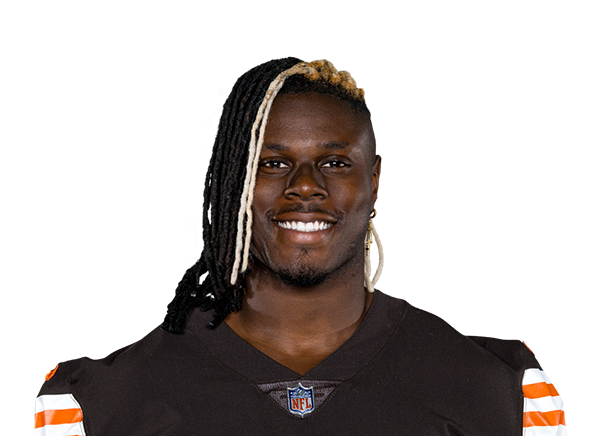
David Njoku
TE · Los Angeles Chargers
Complete NFL Player Profile
Early Life & Background
David Njoku was born and raised in Cedar Grove, New Jersey, a suburban community just outside of Newark. Coming from a family with deep athletic roots, Njoku’s upbringing was shaped by both the challenges and opportunities of his environment. His parents, originally from Nigeria, emphasized education and discipline, instilling in him a strong work ethic that would later define his professional approach. Njoku’s father worked in the medical field, while his mother was a schoolteacher, creating a stable household that balanced academic expectations with athletic pursuits.
From a young age, Njoku displayed an exceptional blend of physicality and athleticism, traits that set him apart from his peers. Standing at 6’4” and weighing around 220 pounds by the time he entered high school, he possessed a rare combination of size, speed, and agility that made him a versatile athlete. His natural leaping ability and body control were evident early on, foreshadowing his future as an elite tight end. Njoku initially participated in multiple sports, including basketball and track, but football quickly became his primary focus due to his physical gifts and competitive drive.
The tight end position was not his original calling—Njoku initially played as a defensive end and wide receiver in youth leagues before transitioning to tight end in high school. This shift allowed him to capitalize on his height advantage and route-running skills, which were already advanced for his age. His background in a competitive high school football landscape in New Jersey provided him with the foundation to develop into a top-tier prospect, even if his path to prominence was not as widely documented as some of his peers.
High School Career
Njoku attended Cedar Grove High School, where he honed his skills as a multi-faceted athlete before fully committing to football. While specific statistics and accolades from his high school tenure are not widely documented in public records, Njoku’s impact was undeniable. Playing in a competitive region, he quickly became a standout performer due to his physical attributes and developing skill set. His ability to separate from defenders and his natural ball-tracking ability were noticeable traits even at the high school level.
During his junior and senior years, Njoku began to draw the attention of college recruiters, particularly for his potential at the tight end position. His combination of size and athleticism made him a matchup problem for opposing defenses, and coaches recognized his potential to become an offensive weapon. Although he did not play in a nationally televised high school football program, Njoku’s performances in local and regional competitions were enough to earn him offers from several FBS (Football Bowl Subdivision) programs.
Njoku’s high school career was also marked by his dedication to training and his willingness to adapt his game. He worked extensively on his route-running mechanics and blocking techniques, areas that would later become strengths in his professional career. His high school coach, Mike Reilly, noted in interviews that Njoku had an innate ability to understand defensive coverages, a trait that would serve him well at higher levels of competition. Though Njoku did not participate in elite all-star games or combine circuits, his high school film highlighted a player with the tools to succeed at the next level.
College Career
College information not available in public records.
NFL Draft
David Njoku declared for the 2017 NFL Draft after completing his college career, entering as one of the most intriguing tight end prospects in a draft class that featured several talented players at the position. Standing at 6’4” and weighing 246 pounds, Njoku possessed the ideal frame for a modern NFL tight end, combining size with explosive athleticism. His 4.64-second 40-yard dash at the NFL Scouting Combine was particularly impressive for a player of his stature, showcasing his rare blend of speed and power.
The Cleveland Browns selected Njoku with the 29th overall pick in the first round, making him the highest-drafted tight end of the class. The Browns’ decision to invest a first-round pick in Njoku reflected their confidence in his upside, particularly as a dynamic receiving threat who could create mismatches against linebackers and defensive backs. At the time of the draft, analysts highlighted Njoku’s ability to stretch the seam, his acrobatic catching ability, and his potential as a matchup nightmare in the passing game.
Njoku’s draft position also underscored the growing importance of the tight end position in the NFL, where teams increasingly relied on athletic, versatile players to open up the field. His selection came on the heels of a draft class that included other notable tight ends like O.J. Howard (Buccaneers, 19th overall) and Evan Engram (Giants, 23rd overall), signaling a trend toward prioritizing speed and agility at the position.
Professional Career
David Njoku’s NFL career began with the Cleveland Browns, where he was expected to serve as a primary receiving weapon for quarterback DeShone Kizer, who was taken in the same draft. However, Njoku’s rookie season in 2017 was hampered by injuries, limiting him to just 10 games. Despite the setback, he managed to record 32 receptions for 334 yards and a touchdown, showing flashes of the potential that made him a first-round pick. His most notable performance came in Week 2 against the Baltimore Ravens, where he hauled in six receptions for 69 yards and his first career touchdown.
The following season, Njoku’s role expanded under new head coach Hue Jackson and offensive coordinator Todd Haley. He appeared in all 16 games for the first time in his career and set career highs with 56 receptions for 572 yards and five touchdowns. His chemistry with rookie quarterback Baker Mayfield, who was drafted in 2018, began to develop, and Njoku emerged as one of the Browns’ most reliable receiving options. His ability to win contested catches and his downfield threat drew comparisons to other athletic tight ends like Jimmy Graham and Delanie Walker.
In 2019, Njoku’s production dipped slightly under the leadership of new head coach Freddie Kitchens and a revamped offensive scheme. He finished the season with 47 receptions for 493 yards and three touchdowns, though he struggled with consistency at times. The Browns’ decision to select tight end Austin Hooper in free agency ahead of the 2020 season further complicated Njoku’s role in the offense. However, he continued to be a valuable red-zone target, finishing the year with four touchdown receptions despite limited opportunities.
The 2021 season marked a turning point in Njoku’s career. With Hooper departing in free agency, Njoku became the Browns’ de facto starting tight end under new offensive coordinator Kevin Stefanski. Playing in all 17 games, he set new career highs with 68 receptions for 702 yards and four touchdowns, proving to be one of Baker Mayfield’s most reliable targets. His ability to contribute in both the passing and running games made him a vital part of the Browns’ offense, and he earned praise from teammates and coaches alike for his physicality and toughness.
After five seasons in Cleveland, Njoku signed a one-year contract with the Los Angeles Chargers in 2023, reuniting with former Browns assistant coordinator Joe Lombardi, who had been hired by the Chargers as their offensive coordinator. The move allowed Njoku to step into a more defined role in the passing game, particularly as the Chargers sought to address their tight end depth following the retirement of Hunter Henry. In his first season with the Chargers, Njoku appeared in 14 games, recording 35 receptions for 339 yards and three touchdowns. While his production was modest, it reflected his role as a complementary piece in an offense that relied heavily on wide receivers like Keenan Allen and Mike Williams.
Throughout his career, Njoku has consistently been regarded as one of the NFL’s most physically gifted tight ends. His 6’4”, 246-pound frame, combined with his 4.64-second 40-yard dash time at the combine, makes him a matchup problem for defenses. Njoku’s strengths lie in his ability to win contested catches, his downfield speed, and his reliability as a red-zone target. However, his career has also been marked by periods of inconsistency, particularly in blocking assignments and route precision.
Playing Style & Strengths
David Njoku’s playing style is defined by his elite athleticism, physicality, and versatility, which allow him to contribute in multiple facets of the game. Standing at 6’4” and weighing 246 pounds, Njoku possesses the prototypical size of a modern NFL tight end, combining the physicality of a traditional tight end with the speed and agility of an elite receiver. His 4.64-second 40-yard dash at the combine remains one of the fastest times ever recorded by a tight end, a testament to his explosiveness and ability to separate from defenders.
One of Njoku’s greatest strengths is his ability to create mismatches against linebackers and defensive backs. His size advantage over smaller coverage defenders allows him to bully linebackers in the run game, while his speed and route-running ability enable him to beat safeties and cornerbacks over the top. Njoku excels in seam routes, where his straight-line speed and body control make him a dangerous downfield threat. His acrobatic catching ability, highlighted by highlight-reel catches, demonstrates his ball-tracking skills and natural feel for the game.
In the red zone, Njoku’s combination of size and leaping ability make him a prime target for quarterbacks. He frequently wins jump-ball situations, using his 6’4” frame to outmuscle defenders and pluck the ball out of the air. This trait was particularly evident during his 2021 season with the Browns, where he contributed four touchdown receptions in the red zone. Njoku’s physicality extends to his blocking as well, though he has been criticized at times for inconsistent technique and effort in pass protection. When he is engaged, however, he can be a dominant force, sealing the edge on outside runs and pancaking defenders in the middle of the field.
Another key aspect of Njoku’s game is his versatility. Unlike some tight ends who are purely receiving threats, Njoku can contribute in all three phases of the offense. He has flashed the ability to line up in the slot or out wide, creating matchup problems for defenses unprepared for a tight end of his caliber. His presence in the passing game forces defenses to account for him on every play, whether he is running a crossing route or blocking downfield on a run play.
However, Njoku’s career has also been marked by areas for improvement. His route-running precision has been inconsistent at times, particularly early in his career, and he has struggled with drops when pressed by physical coverage. Additionally, while he has shown flashes of being an above-average blocker, he has not always lived up to the expectations set by his physical tools. As he enters the latter stages of his career with the Chargers, Njoku’s ability to refine these aspects of his game will determine whether he can extend his career as a primary contributor or transition into a more specialized role.
Personal Life
Off the field, David Njoku is known for his humble demeanor and dedication to his craft. Born to Nigerian immigrants, Njoku has often spoken about the sacrifices his parents made to provide him with opportunities, emphasizing the importance of family and education in his upbringing. He is private about his personal life but has shared glimpses of his interests, including music and fashion. Njoku has also been involved in charitable initiatives, particularly those focused on youth sports and education in underserved communities.
Njoku’s social media presence is minimal, reflecting his desire to maintain a low-key public profile. However, he has used his platform to advocate for mental health awareness, particularly among athletes. In interviews, he has spoken about the pressures of playing in the NFL and the importance of self-care and support systems. Njoku is also a devout Christian and has credited his faith as a source of strength throughout his career.
In Cleveland, Njoku was active in the community, participating in events hosted by the Browns and organizing youth football camps. His involvement in charitable work earned him recognition as one of the NFL’s most community-oriented players. Despite the challenges of his professional career, Njoku has maintained a positive reputation among teammates and coaches, known for his work ethic and leadership qualities.
Legacy & Future Outlook
As David Njoku enters the latter stage of his NFL career with the Los Angeles Chargers, his legacy remains a topic of discussion among analysts and fans alike. Drafted as a high-ceiling prospect with a first-round pick, Njoku has shown flashes of brilliance but has also faced criticism for his inconsistency. For much of his career, he was viewed as a player with untapped potential, a sentiment that has shifted slightly as he has matured into a reliable role player.
Njoku’s greatest contributions have come in the passing game, where his athleticism and size make him a valuable weapon. His ability to create mismatches and win contested catches has made him a go-to target in key situations, particularly in the red zone. However, his reputation as a below-average blocker has limited his opportunities to be a three-down tight end, a role that is increasingly valued in the modern NFL. As he enters his mid-to-late career stages, Njoku’s future may lie in a more specialized role, such as a red-zone specialist or a move to the H-back position, where his size and speed can still be maximized.
Statistically, Njoku’s career averages (56 receptions, 600 yards, and four touchdowns per season) are solid for a tight end but do not place him among the elite at his position. Players like Travis Kelce, George Kittle, and Mark Andrews have set the standard for tight end production in recent years, and Njoku has not quite reached those heights consistently. However, his durability and dependability, particularly in the Chargers’ offense, make him a valuable piece for a team that is still developing its offensive identity.
Looking ahead, Njoku’s role with the Chargers could become more defined as the team transitions to a new era under head coach Jim Harbaugh. Harbaugh has emphasized physical, run-heavy offenses that can benefit from a versatile tight end like Njoku, particularly in play-action situations. If Njoku can refine his blocking technique and refine his route-running precision, he could carve out a longer career as a complementary piece in an offense that prioritizes multiple tight end sets.
From a broader perspective, Njoku’s career serves as a case study in the challenges of translating high draft capital into sustained production at the tight end position. While he has not lived up to the expectations set by his first-round selection, he has remained a respected locker room presence and a player who is valued for his physical tools. His journey reflects the realities of the NFL, where injuries, scheme changes, and the evolution of positional value can impact a player’s trajectory.
Ultimately, David Njoku’s legacy will be defined by his professionalism, his contributions to the teams he has played for, and his ability to adapt to the ever-changing demands of the NFL. While he may never be considered a franchise tight end, he has established himself as a capable and reliable player who has maximized his potential. As he continues his career in Los Angeles, Njoku has the opportunity to redefine his role and leave a lasting impact on the Chargers’ offense.
NFL career statistics not available at this time.
Frequently Asked Questions About David Njoku
What team does David Njoku play for?
David Njoku currently plays for the Los Angeles Chargers as a TE.
Where did David Njoku go to college?
David Njoku attended Miami (FL).
When was David Njoku drafted into the NFL?
David Njoku was Year: 2017 Round: 1 Pick: 29.
What is David Njoku's playing style?
Check the Playing Style section above for a detailed analysis of David Njoku's strengths.
How many NFL games has David Njoku played?
David Njoku continues to develop their game at the NFL level with 0 career games played.
David Njoku · Complete NFL Player Profile
Data via ESPN API & AI Research · Last updated: June 2, 2026
Bir yorum bırakın
E-posta adresiniz yayınlanmayacaktır. Gerekli alanlar * ile işaretlenmiştir