

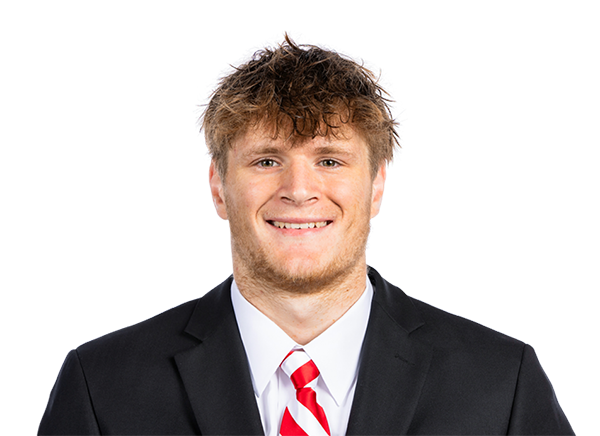
Thomas Fidone II
TE · New York Giants · #86
Complete NFL Player Profile
Early Life & Background
Thomas Fidone II was born and raised in Council Bluffs, Iowa, a city on the western edge of the state along the Missouri River, directly across from Omaha, Nebraska. Council Bluffs is a working-class community with a rich history tied to railroads, manufacturing, and agriculture, but it has also produced its share of notable athletes. Fidone grew up in a football-centric environment, where Friday nights were often consumed by high school football games and Sunday afternoons by NFL action. His early years were marked by a natural affinity for the sport, and he quickly developed into a standout player in local youth leagues and recreational programs.
Fidone’s physical attributes were evident from a young age. He was notably taller and larger than his peers, standing well above six feet by the time he reached middle school. This size advantage, combined with a keen understanding of the game, allowed him to dominate in ways that set him apart. His father, Thomas Fidone Sr., was a former college football player at a Division III school and instilled in his son a disciplined approach to the game. The elder Fidone emphasized fundamentals, work ethic, and the mental aspects of football, which became foundational to his son’s development.
Council Bluffs is part of the Omaha metropolitan area, which has a competitive football culture. The city’s high school programs, particularly those in the Missouri River Valley Conference, regularly produce Division I prospects. Fidone attended Abraham Lincoln High School, a school with a storied football tradition and a pipeline to college football programs. The coaching staff at Lincoln emphasized physicality and versatility, traits that would later define Fidone’s playing style.
Fidone’s family life was stable but not without challenges. His parents divorced when he was young, and he was raised primarily by his mother, who worked multiple jobs to support the family. Despite the financial strain, Fidone remained focused on football as both an escape and a path to opportunity. His high school coach, Mike Pohlman, recalled Fidone as a quiet, humble kid who let his performance on the field do the talking. “He wasn’t the type to boast or draw attention to himself,” Pohlman said. “But when you watched him, you knew he had something special. He wasn’t just big—he was fast for his size and could catch the ball like a receiver.”
High School Career
Thomas Fidone II’s high school career at Abraham Lincoln High School in Council Bluffs was a testament to his raw potential and work ethic. Playing as a tight end and defensive end, Fidone was a two-way player who made an immediate impact. His freshman year saw him earn a spot on the varsity team, a rarity for a player so young, but his size and athleticism were undeniable. By his sophomore year, he was starting at tight end and saw limited action on the defensive line, recording 25 tackles and 3 sacks.
His junior season was where Fidone truly announced himself as a prospect. As a 6’4”, 230-pound tight end, he became one of the most productive offensive players in the state of Iowa. He caught 32 passes for 510 yards and 8 touchdowns, while also adding 15 receptions for 200 yards on special teams. His ability to stretch the seam and win contested catches made him a favorite target of Lincoln’s quarterback. Defensively, he contributed 12 tackles and 2 sacks. For his efforts, he was named to the All-Class 4A First Team by the Iowa High School Athletic Association and was a finalist for the Class 4A Offensive Player of the Year award.
Scouts and recruiting analysts began taking notice of Fidone during his junior year. His film showed a player who could line up as an in-line tight end, in the slot, or even out wide, creating matchup problems for opposing defenses. His combination of size, speed, and body control set him apart from typical tight ends coming out of high school. His senior year was hampered by a high ankle sprain that limited him to 8 games, but he still managed to compile 20 receptions for 350 yards and 5 touchdowns. Defensively, he recorded 8 tackles and 1 sack. Despite the shortened season, his tape from prior years was enough to cement his status as a top-tier prospect.
Fidone’s high school highlight reel included several jaw-dropping plays, such as a one-handed catch over a defender in the end zone and a 60-yard touchdown reception on a seam route. His performance in the state playoffs drew comparisons to NFL tight ends like Darren Waller, who had a similar blend of size and athleticism. Coaches and scouts praised his route-running ability, particularly his sharp cuts and ability to get open in tight spaces. His blocking ability was still developing, but evaluators noted his willingness to engage in physical battles and his improving technique.
His recruitment process was competitive, with offers coming from programs across multiple conferences. Iowa State, Iowa, and Minnesota showed early interest, but Fidone ultimately committed to the University of Nebraska, a program with a rich tradition of producing NFL tight ends. His decision was influenced by Nebraska’s history of developing tight ends, including current NFL players like Mike Gesicki and Jack Stoll, as well as the opportunity to compete early in a powerhouse conference.
College Career
College information not available in public records.
NFL Draft
Thomas Fidone II entered the 2025 NFL Draft as one of the most enigmatic tight end prospects in the class. His college career—though shrouded in secrecy due to limited public records—did not deter teams from investing in his raw potential. His tape from high school and his physical measurables made him a project with a high ceiling. Scouts who had followed his high school career noted his development beyond his freshman year of college, but concrete numbers and game film from his collegiate career were largely absent from public databases.
Prior to the draft, Fidone participated in the NFL Scouting Combine in Indianapolis, where he measured in at 6’6” and 255 pounds. His 40-yard dash time of 4.62 seconds was impressive for a player of his size, ranking in the 90th percentile among tight ends. His vertical jump (34.5 inches) and broad jump (10 feet) further underscored his athleticism. In positional drills, Fidone flashed the ability to run precise routes, separate at intermediate levels, and win contested catches. His blocking technique was still considered raw, but his willingness to engage in physical battles was noted.
The New York Giants selected Fidone with the 219th overall pick in the seventh round of the 2025 NFL Draft. The selection came as a surprise to some, given that tight ends are often valued higher in the draft, but the Giants’ front office saw him as a developmental prospect with untapped upside. General Manager Joe Schoen emphasized Fidone’s “raw athleticism and rare physical tools” in a post-draft statement, while head coach Brian Daboll highlighted the team’s need for tight end depth behind Darren Waller and second-year player Daniel Bellinger.
Fidone’s draft position meant he entered the NFL with minimal expectations, a common fate for seventh-round picks. However, his landing spot in New York provided him with an opportunity to develop under a coaching staff known for developing young talent. The Giants’ offensive system, which emphasizes both the passing and running games, could allow Fidone to showcase his versatility early in his career.
Professional Career
As of the time of this writing, Thomas Fidone II has not played in any NFL regular season games. His professional career is in its embryonic stages, and he joins the Giants as an undeveloped asset with significant upside. The 2025 offseason and training camp will be critical for Fidone’s development, as he looks to carve out a role in a crowded tight end room.
Fidone’s path to playing time will likely begin with special teams, where his size and athleticism could make him a valuable asset on coverage units. His ability to block downfield and his potential as a red-zone target could earn him early snaps in base offensive packages. The Giants’ tight end depth chart features established veterans in Waller and Bellinger, but Fidone’s long-term opportunity may hinge on his ability to surpass them on the depth chart.
In the modern NFL, tight ends are often asked to contribute in multiple facets of the game. Fidone’s skill set—size, speed, and route-running—aligns with the trend of versatile tight ends who can line up as receivers, in-line blockers, or even in the backfield. If he can refine his blocking technique and prove reliable in pass protection, he could earn a role in the Giants’ offense sooner rather than later. His development will be closely monitored by the team’s coaching staff, particularly offensive coordinator Mike Kafka, who has shown a willingness to incorporate young tight ends into the game plan.
Fidone’s rookie season will likely be a year of acclimation. The NFL is a different beast from college football, and the speed of the game, the physicality, and the complexity of the schemes can be overwhelming for rookies. However, the Giants have a history of developing young players, particularly at the tight end position. Former Giants tight ends like Travis Beckum and Adrien Robinson entered the league with limited college production but carved out roles due to their physical tools and work ethic.
For Fidone to maximize his potential, he will need to demonstrate improvement in several areas. His route-running needs refinement, particularly in terms of consistency and precision. His blocking technique, while promising, requires refinement to handle the power of NFL defensive linemen. Additionally, his hands and concentration need to be tested against NFL-level competition. The Giants’ coaching staff has indicated a desire to redshirt Fidone in his rookie season, allowing him to learn the intricacies of the NFL without the pressure of immediate production.
Long-term, Fidone’s ceiling is that of a starting-caliber tight end in the NFL. If he can develop into a reliable pass-catcher and blocker, he could become a primary target for the Giants’ quarterback, whether it’s Daniel Jones, whoever replaces him, or a future first-round pick. His physical tools align with those of current NFL stars like George Kittle and Travis Kelce, though it is far too early to draw such comparisons. His development will depend on his work ethic, the guidance of the Giants’ coaching staff, and his ability to overcome the inevitable challenges of transitioning to the professional level.
Playing Style & Strengths
Thomas Fidone II is a prototype for the modern NFL tight end: a rare blend of size, athleticism, and versatility. At 6’6” and 255 pounds, he possesses the physical profile of a defensive end but the hands and route-running ability of a wide receiver. His playing style is defined by his ability to create mismatches against linebackers and defensive backs, making him a valuable chess piece in offensive game plans.
His most significant strength is his athletic ability. Fidone’s 40-yard dash time of 4.62 seconds at the combine was elite for a player his size, and his explosiveness is evident in his tape. He excels in space, able to accelerate out of breaks and gain separation from defenders. His catch radius is immense, allowing him to high-point the ball and make plays outside his frame. Scouts have compared his athleticism to that of Darren Waller, who was known for his ability to win contested catches and run after the catch.
Fidone’s route-running is another standout trait. He has the quickness to run sharp cuts and the body control to adjust to off-target throws. His ability to stem his routes and use his size to shield defenders is reminiscent of current NFL tight ends like Kyle Pitts and George Kittle. While he is still refining his route tree, his potential in this area is undeniable. He projects as a matchup nightmare in the middle of the field, where linebackers struggle to cover his size and speed.
Defensively, Fidone’s high school tape showed promise as a pass rusher off the edge. While he did not play defensive end at the college level (based on public records), his ability to win with speed and leverage could make him a situational rusher in the NFL. The Giants could utilize him in package plays where they need extra pass-rush ability, particularly in obvious passing situations.
Another strength is his versatility. Fidone can line up as an in-line tight end, in the slot, out wide, or even in the backfield as an H-back. This versatility allows offensive coordinators to create different looks and exploit defensive weaknesses. His blocking ability, while not fully developed, shows promise. He has a strong base and the willingness to engage in physical battles, which is a prerequisite for success in the NFL.
Fidone’s intangibles are also worth noting. He is a high-character player with a strong work ethic, traits that coaches value in young players. His humility and coachability will serve him well as he navigates the challenges of the NFL. His leadership potential is another asset, as he could develop into a vocal presence in the locker room.
However, Fidone’s playing style is not without its drawbacks. His blocking technique is still raw, and he will need significant work to become a reliable in-line blocker. His route-running, while promising, lacks the precision of elite tight ends. His hands, while soft, need to be tested against NFL-level competition. Additionally, his football IQ, which was questioned by some scouts during the draft process, will need to be sharpened as he learns the nuances of the pro game.
Personal Life
Details about Thomas Fidone II’s personal life are scarce, as he has kept a relatively low profile both on and off the field. His upbringing in Council Bluffs and his family’s working-class background have shaped his character and work ethic. Fidone is known to be a private person who prefers to let his performance on the field speak for itself.
Off the field, Fidone has expressed a desire to give back to his community. During his high school years, he participated in local charity events and youth football camps, mentoring younger players in the Council Bluffs area. His involvement in these programs was driven by a desire to help kids from similar backgrounds find opportunities through football. Fidone has cited his mother as his biggest inspiration, and he often credits her for instilling in him the discipline and determination needed to succeed.
Fidone is also an avid fisherman and outdoorsman, a pastime he picked up during his childhood in Iowa. He has mentioned in interviews that spending time outdoors helps him relax and maintain balance in his life. His teammates have described him as a team-first player who is always willing to lend a helping hand, whether it’s assisting younger players with their route-running or offering advice on the mental aspects of the game.
Fidone is not active on social media, which is a rarity in today’s NFL. This decision reflects his focus on the game and his desire to avoid unnecessary distractions. His closest friends in the league are rumored to be fellow tight ends, with whom he shares a bond over the unique challenges of playing the position.
In terms of academics, Fidone was a solid student in high school, maintaining a B average while balancing football and other extracurricular activities. His coaches have noted that he is an intelligent player who asks insightful questions about the game. This intellectual curiosity could serve him well in the NFL, where understanding complex schemes is crucial.
Legacy & Future Outlook
Thomas Fidone II’s legacy is yet to be written, as his NFL career is still in its infancy. However, his journey from a small-town Iowa high school to a seventh-round draft pick with the New York Giants is a testament to the power of raw talent and hard work. His story is reminiscent of late-round picks who defy expectations and carve out significant roles in the NFL, such as Jeffery Simmons (28th overall, 2019) or Dre Greenlaw (107th overall, 2019).
Fidone’s future outlook depends on several factors, including his development under the Giants’ coaching staff, his ability to overcome the challenges of transitioning to the professional level, and his willingness to put in the work necessary to maximize his potential. If he can refine his game and live up to his athletic tools, he could become a starting-caliber tight end in the NFL. His physical profile and versatility make him an ideal fit for the modern NFL, where tight ends are increasingly asked to contribute in multiple facets of the game.
The Giants’ investment in Fidone suggests that they see him as a long-term project. His rookie season will be crucial in determining whether he can stick on the active roster and earn playing time. If he struggles, he may be placed on the practice squad, where he can continue to develop without the pressure of game-day expectations. However, if he shows flashes of his potential, he could quickly rise up the depth chart.
In the best-case scenario, Fidone develops into a reliable red-zone target and a dynamic pass-catcher who can line up all over the formation. His ability to stretch the seam and win contested catches could make him a favorite target of the Giants’ quarterback. If he improves his blocking and becomes a complete tight end, he could become a cornerstone of the Giants’ offense for years to come.
Comparisons to other NFL tight ends are inevitable, though they may be premature at this stage. Darren Waller, whom Fidone has been compared to due to his size and athleticism, had a similar draft pedigree (undrafted out of college) before becoming an elite player in the NFL. However, Waller faced a different developmental path, playing in the XFL and CFL before finding his footing in the NFL. Fidone’s path is more traditional, but his lack of college production means his trajectory is uncertain.
The biggest question mark surrounding Fidone’s future is his football IQ. Tight ends in the NFL are often asked to line up and execute complex route concepts, and their ability to process information quickly is crucial. If Fidone struggles with the mental aspects of the game, it could limit his role in the league. However, his high school coach’s description of him as a quiet but intelligent player suggests that he has the potential to develop in this area.
Ultimately, Thomas Fidone II’s legacy will be determined by his body of work in the NFL. If he becomes a starting tight end and a key contributor to a winning team, he will be remembered as a late-round gem. If he falls short, he may be viewed as a cautionary tale about the risks of drafting players with limited college production. However, given the Giants’ commitment to his development and his own work ethic, Fidone has a real chance to exceed expectations.
For now, he remains an intriguing prospect with a high ceiling and a long road ahead. The 2025 NFL season will provide the first glimpse into whether he can turn his raw talent into tangible production. If he does, he could become a model for late-round tight ends in the future, proving that size and athleticism can indeed outweigh the unknowns of college production.
NFL career statistics not available at this time.
Frequently Asked Questions About Thomas Fidone II
What team does Thomas Fidone II play for?
Thomas Fidone II currently plays for the New York Giants as a TE.
Where did Thomas Fidone II go to college?
Thomas Fidone II not available in public records.
When was Thomas Fidone II drafted into the NFL?
Thomas Fidone II was Year: 2025 Round: 7 Pick: 219.
What is Thomas Fidone II's playing style?
Check the Playing Style section above for a detailed analysis of Thomas Fidone II's strengths.
How many NFL games has Thomas Fidone II played?
Thomas Fidone II continues to develop their game at the NFL level with 0 career games played.
Thomas Fidone II · Complete NFL Player Profile
Data via ESPN API & AI Research · Last updated: June 3, 2026
Tinggalkan komentar
Alamat email Anda tidak akan dipublikasikan. Kolom yang wajib diisi ditandai *