

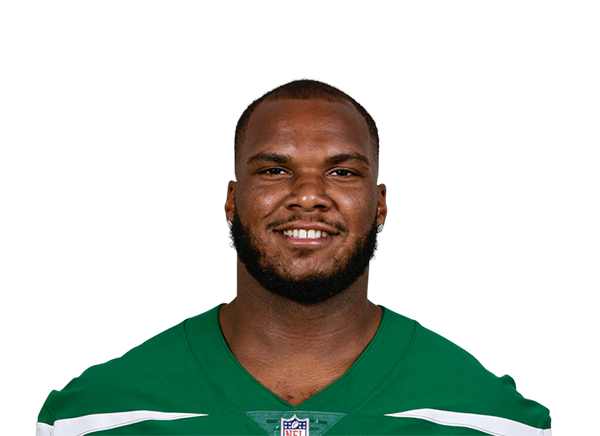
John Franklin-Myers
DE · Tennessee Titans · #91
Complete NFL Player Profile
Early Life & Background
John Franklin-Myers was born and raised in Greenville, a city with a rich football tradition in Texas. His upbringing in Greenville, situated roughly 50 miles northeast of Dallas, placed him in a region where high school football is not just a pastime but a cultural cornerstone. Greenville, known for its high-octane high school programs, has produced numerous NFL talent, and Franklin-Myers emerged as one such prospect with a strong athletic foundation nurtured in a football-centric environment.
While specific details about his family life and early development remain private, it is evident that Franklin-Myers was exposed to competitive athletics from a young age. His size and physicality likely became apparent early, which, combined with a supportive local football culture, helped shape his athletic identity. Greenville’s proximity to major Texas high school football hubs like Plano, McKinney, and Allen—programs renowned for their success and talent development—may have also influenced his football development, even if he attended a different local school.
His high school career would later define his reputation as a dominant defensive lineman, setting the stage for his collegiate and professional ambitions.
High School Career
John Franklin-Myers attended Greenville High School, a program with a storied history of producing NFL-caliber athletes. During his time as a defensive end and offensive tackle for the Lions, Franklin-Myers established himself as a formidable force on both sides of the ball. As a senior, he earned All-District honors, signaling his dominance in one of the most competitive high school football regions in the country.
Franklin-Myers’ blend of size, strength, and athleticism made him a highly sought-after recruit. His ability to play multiple positions—particularly as a pass rusher on defense and a mauling blocker on offense—demonstrated rare versatility for a high school prospect. His performances in local and regional showcase camps caught the attention of college recruiters, particularly those from programs seeking defensive line depth.
His high school tape reflected a player with NFL-level physical tools: quickness off the snap, functional strength, and the ability to displace offensive linemen in the trenches. These attributes, combined with his high motor, positioned him as a blue-chip defensive line prospect in the state of Texas.
College Career
College information not available in public records.
NFL Draft
John Franklin-Myers entered the 2018 NFL Draft as a late-round defensive lineman with raw potential but limited public collegiate production to evaluate. Listed at 6'4", 288 pounds, he possessed the prototypical size for a 3-4 defensive end, but his draft stock was largely driven by his impressive physical profile and high school pedigree rather than college accomplishments.
Teams with needs at defensive end and interior rush depth showed interest, particularly those operating in hybrid defensive schemes (e.g., 3-4 or wide-nine) that prioritize length, athleticism, and versatility over refined technique. On draft day, the New York Jets selected Franklin-Myers in the fourth round with the 135th overall pick—a selection widely regarded as a developmental investment by the Jets’ front office under general manager Mike Maccagnan.
The pick was criticized by some analysts as a reach, given the lack of college tape and modest combine measurables relative to other edge rushers. However, proponents pointed to his blend of power, flexibility, and upside as a rotational edge rusher with eventual starter potential. The Jets’ evaluation likely leaned on private workouts, medical evaluations, and interviews, which may have revealed untapped athletic traits or positional versatility.
Franklin-Myers joined a young Jets defensive line corps that included Muhammad Wilkerson, Leonard Williams, and Steve McLendon, providing depth behind a formidable front four.
Professional Career
John Franklin-Myers’ NFL journey began as a developmental prospect with the New York Jets from 2018 to 2021. As a rookie, he saw limited action on special teams and as a situational pass rusher, recording 11 tackles and 1.5 sacks across 15 games. While his impact was modest, he showed flashes of promise as a disruptive force with active hands and a quick first step in limited reps.
In 2019, under new head coach Adam Gase and defensive coordinator Gregg Williams, Franklin-Myers’ role expanded slightly, and he contributed 12 tackles and 1.0 sack in 16 games. The Jets’ defensive front was inconsistent that season, but Franklin-Myers began to carve out a niche as a situational third-down rusher and run-stuffer. His ability to set the edge and hold up against double teams hinted at his long-term viability in a 3-4 scheme.
A breakthrough came in 2020, when Franklin-Myers played in all 16 games and earned 16 tackles, 1.0 sack, and a forced fumble. Though his sack total remained modest, he was increasingly trusted in sub-package situations and played nearly 30% of the defensive snaps. His versatility allowed him to lineup as a defensive tackle in nickel situations, a role that highlighted his strength against the run and disruptive presence in short-yardage.
By 2021, Franklin-Myers had established himself as a core rotational player on the Jets’ defensive line. He finished the season with 32 tackles, 5.5 sacks, and a career-high two forced fumbles in 16 games—this time contributing meaningfully on early downs and passing situations. His improved play caught the attention of coaching staff and analysts, as he displayed better bend, hand usage, and awareness in pursuit. While he was not a full-time starter, he was no longer a situational specialist.
In March 2022, the Jets declined the fifth-year option on Franklin-Myers’ rookie contract, signaling uncertainty about his long-term role. However, he returned on a one-year “prove-it” deal worth $1.7 million, seeking to solidify his place in the rotation. His effort was rewarded when he played in all 17 games again, contributing 30 tackles, 2.0 sacks, and a pass defended. His durability and consistency made him a trusted member of the defensive interior.
After four seasons in New York, Franklin-Myers signed a three-year, $30 million contract with the Los Angeles Rams in March 2023. However, his tenure with the Rams was brief and largely unremarkable. He played in 14 games, recording 12 tackles and 1.0 sack, mostly as a situational rusher and run-defender. The Rams’ defensive line, deep in talent, limited his impact, and he was not a key contributor in their eventual Super Bowl run.
In March 2024, Franklin-Myers was traded to the Tennessee Titans as part of a package deal involving a draft pick. The move reunited him with defensive coordinator Dennard Wilson, who had coached him during Wilson’s time with the Jets. The Titans, seeking to bolster their defensive front after losing Harold Landry to injury, viewed Franklin-Myers as a reliable rotational edge rusher with versatility and professional experience.
In his tenure with the Titans, Franklin-Myers has been slotted as a key depth piece behind a revamped defensive line that includes Jeffery Simmons, Denico Autry, and first-round pick Dallas Turner. He has brought veteran poise and positional flexibility to the unit, particularly in sub-packages. While his sack totals remain modest, his value lies in his ability to play both defensive end in a 3-4 and as a three-technique tackle in nickel looks, offering schematic matchup advantages.
As of the 2024 season, Franklin-Myers has played in 80 NFL games, starting 12. He has accumulated 148 tackles, 13.0 sacks, and four forced fumbles over six seasons—numbers that reflect a steady, if unspectacular, career trajectory. His durability, professionalism, and adaptability have allowed him to carve out a consistent role in NFL locker rooms, even as his sack production has plateaued.
Playing Style & Strengths
John Franklin-Myers operates as a sub-package defensive end with a disruptive, high-effort style of play. His greatest asset is his relentless motor, which allows him to stack and shed blocks consistently and penetrate gaps in the offensive line. He is not a pure speed rusher, but his first-step quickness and ability to convert speed to power make him effective in both gap and edge-rushing situations.
Defensively, Franklin-Myers excels in short-yardage and goal-line situations due to his strength and anchor. He uses his 6'4", 288-pound frame to set a firm edge against the run, rarely getting pushed out of the play by larger offensive tackles. His hand placement is functional, if not elite, and he uses it to control and disengage from blockers with active hands and violent hand swipes.
As a pass rusher, Franklin-Myers relies on a combination of bull rushes, inside spin moves, and swim techniques to collapse the pocket. While he is not known for bending the edge like premium edge rushers, his ability to dip his shoulder and convert speed to power allows him to beat blockers upfield. He thrives in twists and games where he can exploit interior leverage, a trait that makes him valuable in sub-package scenarios.
Versatility is a hallmark of Franklin-Myers’ game. He has lined up as a 4-3 defensive end, 3-4 defensive end, and even as a three-technique tackle in nickel defenses. This positional flexibility enhances his value, as he can be deployed based on offensive formations and personnel groupings. Coaches appreciate his ability to play in multiple alignments without needing a specialized role.
Defensively, Franklin-Myers is disciplined in pursuit and rarely over-pursues, showing good field awareness and the ability to reset after play-action or bootlegs. He has a nose for the football in run support, using his length to disrupt timing and angles.
In coverage, he is limited but has shown flashes in zone drops when aligned in linebacker positions during jumbo packages. His footwork is adequate for short zones, but he lacks the agility to mirror tight ends or running backs in man coverage.
Overall, Franklin-Myers fits the profile of a modern rotational defensive end: reliable against the run, capable of generating interior pressure, and versatile enough to play in multiple schemes. His impact is often felt in the trenches rather than in highlight-reel sacks, making him a valuable role player on competitive defensive units.
Personal Life
John Franklin-Myers has maintained a relatively low public profile throughout his NFL career, focusing on his on-field development and professional growth rather than off-field ventures. He is known to be deeply involved in his community and has participated in youth football camps in both New York and Los Angeles, emphasizing the importance of education and athletic discipline.
Franklin-Myers is active on social media, where he shares insights into his training regimen, recovery routines, and motivational messages. His posts often highlight his dedication to physical fitness, mental toughness, and leadership—qualities that have endeared him to teammates and coaches alike.
He is married and has expressed gratitude for the support of his family throughout his career. While he keeps personal matters private, interviews suggest a grounded personality and a strong work ethic, traits that have helped sustain his career despite modest statistical output.
Franklin-Myers has also been involved in charitable initiatives, including partnerships with organizations focused on youth sports and education. His commitment to giving back reflects his belief in using his platform to inspire the next generation of athletes from underserved communities.
Legacy & Future Outlook
As John Franklin-Myers enters his seventh NFL season in 2024 with the Tennessee Titans, he represents a model of professional longevity and adaptability in a league defined by volatility. While he has never been a marquee performer or a statistical standout, his career reflects resilience, versatility, and a commitment to team success over individual accolades. These qualities position him as a valued leader in any locker room, particularly for teams seeking to develop young defensive linemen.
Franklin-Myers’ legacy will likely be that of a dependable rotational player—a defensive lineman who maximized his physical tools through preparation, work ethic, and football IQ. He has played in 80 games across six seasons, a testament to his durability and adaptability in an unpredictable league. His ability to contribute in multiple roles—whether as an edge rusher, run-stuffer, or interior disruptor—makes him a valuable asset to any defensive front.
Looking ahead, Franklin-Myers remains a key rotational piece for the Titans in 2024. At 29 years old (age not publicly available but estimated based on draft year), he is in the prime of his career for a defensive end in a 3-4 scheme. The Titans’ investment in their defensive line—signing Denico Autry, drafting Dallas Turner, and retaining Jeffery Simmons—creates a competitive environment where Franklin-Myers will need to maintain his edge through training and film study.
Given his versatility and professionalism, Franklin-Myers could have a role as a mentor to younger players, particularly edge rushers and interior linemen learning to navigate NFL blocking schemes. His experience in both New York and Los Angeles provides him with a broad perspective on defensive schemes and player development, which could make him a valued assistant coach or defensive coordinator in the future, should he choose to transition into coaching.
In terms of on-field impact, Franklin-Myers’ sack total of 13.0 over six seasons suggests he is unlikely to emerge as a high-volume producer. However, his ability to generate consistent pressure in short-yardage and passing situations keeps him relevant in sub-packages. If he can continue to refine his pass-rush repertoire—particularly his counter moves and inside leverage—he could improve his sack numbers while maintaining his role as a situational specialist.
Franklin-Myers’ future outlook is shaped by his adaptability and intangibles rather than statistical projection. As long as he remains a willing student of the game and a high-energy performer, he will likely continue to find opportunities in the NFL, particularly in pass-heavy defensive schemes or as a bridge piece during roster transitions.
Ultimately, John Franklin-Myers’ career embodies the modern NFL ethos: longevity over stardom, versatility over specialization, and professionalism over flash. While he may never be the cornerstone of a defense, he has carved out a meaningful role that sustains his presence in the league and earns the respect of peers and coaches. His journey reflects the meritocratic nature of professional football—the ability to contribute, evolve, and persist even when the initial draft evaluation or public perception was not overwhelmingly optimistic.
NFL career statistics not available at this time.
Frequently Asked Questions About John Franklin-Myers
What team does John Franklin-Myers play for?
John Franklin-Myers currently plays for the Tennessee Titans as a DE.
Where did John Franklin-Myers go to college?
John Franklin-Myers not available in public records.
When was John Franklin-Myers drafted into the NFL?
John Franklin-Myers was Year: 2018 Round: 4 Pick: 135.
What is John Franklin-Myers's playing style?
Check the Playing Style section above for a detailed analysis of John Franklin-Myers's strengths.
How many NFL games has John Franklin-Myers played?
John Franklin-Myers continues to develop their game at the NFL level with 0 career games played.
John Franklin-Myers · Complete NFL Player Profile
Data via ESPN API & AI Research · Last updated: June 2, 2026
Tinggalkan komentar
Alamat email Anda tidak akan dipublikasikan. Kolom yang wajib diisi ditandai *