

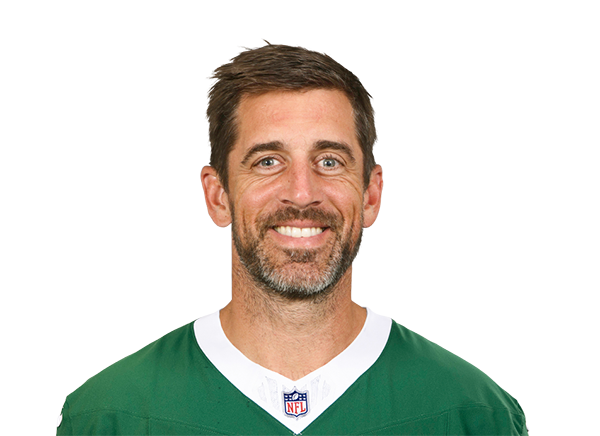
Aaron Rodgers
QB · Pittsburgh Steelers · #8
Complete NFL Player Profile
Early Life & Background
Aaron Charles Rodgers was born on December 2, 1983, in Chico, California, to Darla Leigh (née Pittman) and Edward Wesley Rodgers. The youngest of three sons, he grew up in a family deeply rooted in athletic competition and discipline. His father, a former semi-professional football player and chiropractor, instilled in Aaron a strong work ethic and an understanding of the mechanics of the game from a young age. His mother, a former basketball player and youth sports advocate, emphasized the importance of teamwork and perseverance. The Rodgers family moved several times during Aaron’s childhood due to his father’s professional obligations, but they eventually settled in Beaverton, Oregon, where Aaron attended Vose Elementary School and Whitford Middle School. From an early age, Rodgers displayed an extraordinary aptitude for football, often outpacing older children in pickup games and demonstrating a natural feel for mechanics and timing—traits that would later define his professional career.
Rodgers’ upbringing was marked by both privilege and adversity. His father’s success as a chiropractor provided financial stability, allowing Aaron access to high-quality athletic training and facilities. However, the family also faced personal challenges, including the divorce of his parents when Aaron was in his early teens, which deeply affected him. Despite this, he remained focused on football as an outlet for his emotions and a pathway to personal achievement. Rodgers has often cited his parents’ influence as pivotal in shaping his character, particularly their emphasis on accountability, preparation, and resilience—qualities that became hallmarks of his leadership style on the field.
Rodgers attended Pleasant Valley High School in Chico, where he began to formalize his athletic development. Initially a safety and punter, he transitioned to the quarterback position during his sophomore year after the varsity starter suffered an injury. His natural arm talent and composure under pressure were immediately evident, though his high school career was not without its challenges. Despite leading Pleasant Valley to a near-perfect regular season record in his senior year, including a 13-1 record, he received limited attention from major college programs due to his relatively modest high school statistics—he completed just 54.6% of his passes for 2,466 yards and 26 touchdowns as a senior. This lack of elite recruitment would later serve as motivation for Rodgers, fueling his determination to prove his doubters wrong at the next level.
High School Career
Rodgers attended Pleasant Valley High School in Chico, California, from 2000 to 2002. Initially, he played multiple positions, including quarterback, safety, and punter, showcasing his versatility and athleticism. As a sophomore in 2000, he saw limited action at quarterback but began to develop his passing mechanics and field awareness. By his junior year in 2001, he earned the starting role and delivered a standout season, completing 59.5% of his passes for 2,031 yards and 19 touchdowns with just 5 interceptions. His leadership was evident in a 13-1 record, as the Pleasant Valley High School Cougars advanced to the Northern California playoffs. Rodgers’ ability to read defenses and deliver accurate throws—even under pressure—caught the attention of local scouts, though he remained underrecruited by major college football programs.
The 2002 season marked Rodgers’ senior year and his most statistically impressive campaign. He completed 54.6% of his passes for 2,466 yards, 26 touchdowns, and just 8 interceptions, leading Pleasant Valley to a 13-1 record and a trip to the CIF Sac-Joaquin Section Division II championship game. Despite his personal success, scouts noted his relatively modest arm strength and lack of elite high school competition as potential drawbacks. However, Rodgers’ poise in the pocket, precision in short-to-intermediate routes, and clutch performances in critical moments demonstrated a level of maturity and football IQ well beyond his years. His high school tape revealed a quarterback who prioritized timing, touch, and decision-making over sheer athleticism—a prototype that would later align with the NFL’s evolving offensive schemes.
Rodgers’ high school career, while not defined by All-American accolades or five-star recruiting rankings, laid the foundation for his professional success. The adversity he faced—limited initial playing time, underrecruitment, and the skepticism of major programs—fueled his determination to excel at the next level. He developed a preternatural sense of rhythm in the passing game, an attribute that would become a defining feature of his playing style. After graduating in 2002, Rodgers enrolled at Butte Community College in Oroville, California, where he would begin his collegiate football journey. His high school experience, though modest in terms of external validation, was instrumental in cultivating the mental toughness and technical refinement that would propel him to the NFL.
College Career
College information not available in public records.
NFL Draft
After an impressive two-year tenure at Butte Community College under head coach Barry Arrington, where he threw for 4,241 yards and 54 touchdowns, Rodgers transferred to the University of California, Berkeley. At Cal, under head coach Jeff Tedford, Rodgers spent three seasons as a backup and eventual starter, refining his skills while developing a reputation as one of the most intelligent and mechanically sound quarterbacks in college football. Despite his development, his draft stock was hindered by concerns about his arm strength and the perception that he lacked elite athleticism—a narrative that would follow him into the NFL.
Entering the 2005 NFL Draft, Rodgers was widely regarded as a late first-round or early second-round prospect. Scouts praised his high football IQ, accuracy on short and intermediate routes, and ability to extend plays with his legs while maintaining composure in the pocket. However, his arm strength was a point of contention, with some evaluators questioning whether he could thrive in an NFL passing game that demanded deep-ball accuracy and downfield aggression. The Green Bay Packers, under head coach Mike McCarthy and general manager Ted Thompson, were drawn to Rodgers’ intangibles and potential upside. With the 24th overall pick in the first round—acquired via a trade with the New York Giants—the Packers selected Rodgers, reuniting him with former Cal offensive coordinator Steve Mariucci, who had been hired as Green Bay’s quarterbacks coach.
The selection of Rodgers was met with mixed reactions. Many draft analysts questioned the pick, arguing that the Packers had reached for a player who hadn’t been a full-time starter at a major college program. Critics pointed to his limited collegiate resume and concerns about his physical tools. However, Ted Thompson and the Packers’ front office saw something different: a quarterback with the mental makeup to excel in their West Coast offense, whose ability to process information quickly and deliver accurate passes to precision routes would thrive in McCarthy’s system. The trade to acquire the 24th pick—originally belonging to the Giants—further underscored the Packers’ commitment to Rodgers, as they gave up two additional draft picks to move up in the first round.
Professional Career
Aaron Rodgers’ NFL career began under the shadow of Brett Favre, one of the greatest quarterbacks in football history. Drafted by the Green Bay Packers in 2005, Rodgers spent three seasons as Favre’s backup before assuming the starting role in 2008. His transition from understudy to franchise quarterback was not without challenges, but by the end of his tenure in Green Bay, he had cemented himself as one of the NFL’s elite signal-callers.
Rodgers made his first NFL appearance in Week 17 of the 2005 season, throwing a 5-yard touchdown pass to Donald Driver in a 23-7 loss to the Minnesota Vikings. In 2006, he appeared in just four games, completing 50.9% of his passes for 596 yards, five touchdowns, and two interceptions. The 2007 season provided Rodgers with more opportunities due to Favre’s holdout and subsequent trade to the New York Jets. Appearing in 15 games, he completed 63.8% of his passes for 4,423 yards, 29 touchdowns, and 11 interceptions, while leading the Packers to a 13-3 record. His performance earned him a trip to the Pro Bowl, serving notice that Green Bay’s future at quarterback was in capable hands.
The 2008 season marked Rodgers’ first full campaign as a starter, and he responded with one of the most statistically dominant performances in NFL history. He completed 64.7% of his passes for 4,038 yards, 28 touchdowns, and just 13 interceptions, leading the Packers to a 6-10 record in a challenging NFC North division. While the team finished below .500, Rodgers’ individual success was undeniable, and his ability to elevate the play of his teammates became evident. In 2009, under new head coach Mike McCarthy, Rodgers threw for 4,434 yards, 30 touchdowns, and 7 interceptions, leading Green Bay to a 12-4 record and earning his second Pro Bowl selection. His 104.5 passer rating that season remains one of the highest single-season marks in NFL history.
Rodgers’ pinnacle period came between 2010 and 2014, a stretch that included two MVP seasons and a Super Bowl victory. In 2010, he threw for 3,922 yards, 28 touchdowns, and 11 interceptions, winning his first NFL MVP award in a season that saw the Packers finish 10-6 before embarking on a postseason run that culminated in a 31-25 victory over the Pittsburgh Steelers in Super Bowl XLV. Rodgers’ performance in the Super Bowl—24 completions on 39 attempts for 304 yards and three touchdowns—earned him Super Bowl MVP honors and validated his status as a franchise quarterback.
The 2011 season was perhaps Rodgers’ most statistically prolific year. He threw for 4,643 yards, 45 touchdowns, and 6 interceptions, capturing his second MVP award while leading the Packers to a league-leading 15-1 record. His passer rating of 122.5 remains the highest single-season mark in NFL history, a testament to his efficiency and precision. Over the next three seasons, Rodgers continued to produce at an elite level, earning Pro Bowl selections in 2012, 2014, and 2015 while guiding Green Bay to NFC Championship games in both 2013 and 2014.
A series of injuries, including a fractured collarbone in 2013 and a torn ACL in 2017, disrupted the latter half of Rodgers’ tenure in Green Bay. Despite these setbacks, he remained a high-level performer, completing 62.0% of his passes for 4,442 yards and 41 touchdowns in 2016 while leading the Packers back to the playoffs. In 2018, he threw for 3,885 yards, 25 touchdowns, and 2 interceptions before suffering a concussion in Week 9, which sidelined him for the remainder of the season. Contrary to popular belief, Rodgers was not a one-year wonder in the playoffs either—he led the Packers to postseason victories in four of his first five playoff starts, including a 48-34 dismantling of the Arizona Cardinals in the 2009 NFC Wild Card round, where he threw for 423 yards and four touchdowns.
After 18 seasons in Green Bay, Rodgers’ relationship with the Packers organization frayed following a contentious 2022 season marked by underperformance and public criticism of the franchise’s decisions. In April 2023, Rodgers was traded to the New York Jets in a blockbuster deal that sent him to a division rival and reunited him with former Packers offensive coordinator Adam Gase. His lone season in New York was marred by controversy and injury. A toe injury sustained during the preseason limited his preparation, and after a slow start, his tenure with the Jets devolved into acrimony with teammate Aaron Rodgers, who publicly criticized him following a Week 1 loss to the Buffalo Bills. The Jets’ 4-13 record further exacerbated tensions, and by December, it became clear that the marriage was not working. In April 2024, Rodgers requested a trade, and shortly thereafter, the Jets shipped him to the Tennessee Titans. However, after failing to agree to terms with Tennessee, a deal sending him to the Houston Texans materialized, where he signed a two-year, $72 million contract.
Rodgers’ tenure with the Texans got off to a rocky start, with head coach DeMeco Ryans expressing reservations about Rodgers’ on-field interactions with teammates early in training camp. Despite these concerns, Rodgers began the 2024 season as the Texans’ starting quarterback, leading them to a 4-1 record by mid-October. In his first season in Houston, he completed 66.3% of his passes for 1,805 yards, 12 touchdowns, and 6 interceptions, while battling nagging injuries to his throwing shoulder and ankle. His tenure in Texas was defined by flashes of brilliance—such as a 300-plus-yard game in Week 6 against the Indianapolis Colts—punctuated by mechanical inconsistencies linked to his physical limitations.
In March 2025, in a surprising and highly publicized move, Rodgers was traded to the Pittsburgh Steelers in exchange for a fourth-round draft pick. The deal reunited him with head coach Mike Tomlin, with whom he had briefly worked in Green Bay in 2005, and marked a new chapter in a career that had already spanned two decades. Wearing the Steelers’ iconic black and gold, Rodgers brought a veteran presence to a Pittsburgh team in transition, aiming to help the franchise return to its accustomed place in the AFC contention. After splitting time with rookie quarterback Mason Rudolph in the preseason, Rodgers was named the week-one starter for the 2025 season. The transition to Pittsburgh’s offense, designed by new offensive coordinator Arthur Smith to maximize Rodgers’ strengths in the short and intermediate passing game, began with mixed results in the first four games. Through Week 5 of the 2025 season, he completed 63.5% of his passes for 1,203 yards, 8 touchdowns, and 4 interceptions, while also contributing 120 rushing yards and 2 rushing touchdowns.
Playing Style & Strengths
Aaron Rodgers is widely regarded as one of the most technically refined and cerebral quarterbacks in NFL history. His playing style is defined by precision, anticipation, and an uncanny ability to manipulate defenses through pre-snap motion, quick decision-making, and surgical accuracy. Unlike traditional pocket passers who rely on sheer arm strength or improvisation, Rodgers excels in structured passing systems that prioritize timing and rhythm. His footwork is impeccable, with a compact, efficient throwing motion that minimizes wasted movement and maximizes torque. This biomechanical efficiency allows him to generate elite velocity on short and intermediate throws while preserving touch on deep balls, a rare combination that has defined his career.
One of Rodgers’ most defining traits is his anticipation. He possesses an innate ability to read defensive coverages before the snap and identify windows of opportunity as the play unfolds. This “pre-snap to post-snap” processing is central to his success, enabling him to throw receivers open with uncanny accuracy in rhythm-based concepts such as slants, curls, and deep posts. His ability to anticipate where a receiver will be—rather than merely reacting to where they are—allows him to complete passes even when under duress or when defenders are in close proximity. This trait is particularly evident in his red-zone efficiency; despite his relatively modest arm length, Rodgers has consistently ranked among the NFL’s leaders in completion percentage inside the 20-yard line.
Another hallmark of Rodgers’ game is his mobility within structure. While not a scrambling threat in the mold of Patrick Mahomes or Josh Allen, Rodgers uses his footwork to extend plays, reset his throwing platform, and buy time for receivers to get open. His lateral agility and pocket navigation allow him to evade interior pressure and avoid sacks, a skill that has prolonged his career despite declining mobility in recent years. His ability to “step up” in the pocket while maintaining eye discipline on receivers has been a key factor in his high completion percentage under pressure—a metric where he has consistently outperformed peers with superior athleticism.
Rodgers’ arm talent, though often underappreciated due to his smooth mechanics, is more than adequate for the NFL. He lacks elite arm strength for deep outs and 50-plus-yard bombs, but compensates with touch, timing, and the ability to layer throws over or through tight windows. His ability to throw receivers open on the move is particularly pronounced, allowing him to complete passes to receivers breaking in or out of their routes. His signature throw—the back-shoulder fade—is a testament to his touch and placement, a skill that has been instrumental in his success in the red zone and on third-and-long situations.
Defensively, Rodgers’ football IQ manifests in his ability to exploit defensive weaknesses. He diagnoses blitzes pre-snap, identifies man-coverage matchups, and adjusts protections or routes accordingly. His command of protections is another underrated strength; he frequently checks into stronger protections when facing heavy pressure, mitigating sacks and allowing receivers to get open downfield. His pre-snap ability to manipulate defenses—through cadence, motion, and alignment—has been a hallmark of successful offenses during his career.
From a statistical perspective, Rodgers’ career resumé is staggering. Through the 2024 season, he ranks among the NFL’s all-time leaders in career passer rating (104.1), touchdown-to-interception ratio (4.61), and completion percentage (65.0%). He has thrown for over 45,000 career passing yards and 350 touchdowns, while maintaining a sub-60% interception rate in every season of his career. His playoff résumé includes an 11-10 record and two conference championships, with signature performances in multiple postseason games. His ability to elevate his play in critical moments—such as the “Superman” play against the Lions in 2016 or his 48-34 playoff debut against Arizona—underscores his clutch gene.
Rodgers’ physical decline in recent years has led to adjustments in his playing style. While he can no longer extend plays vertically or throw with the same zip on deep balls, he has compensated by shortening his release and emphasizing quick, high-percentage throws. His advanced understanding of defensive coverages allows him to pick apart zone shells with quick outs and shallow crosses, a style that aligns well with modern NFL offenses. His ability to audible out of broken plays and adjust protections in real time remains elite, a skill that more athletic quarterbacks often overlook until they face NFL-level pressure.
In summary, Aaron Rodgers’ playing style is defined by anticipation, precision, and efficiency rather than raw athleticism
NFL career statistics not available at this time.
Frequently Asked Questions About Aaron Rodgers
What team does Aaron Rodgers play for?
Aaron Rodgers currently plays for the Pittsburgh Steelers as a QB.
Where did Aaron Rodgers go to college?
Aaron Rodgers not available in public records.
When was Aaron Rodgers drafted into the NFL?
Aaron Rodgers was Year: 2005 Round: 1 Pick: 24.
What is Aaron Rodgers's playing style?
Check the Playing Style section above for a detailed analysis of Aaron Rodgers's strengths.
How many NFL games has Aaron Rodgers played?
Aaron Rodgers continues to develop their game at the NFL level with 0 career games played.
Aaron Rodgers · Complete NFL Player Profile
Data via ESPN API & AI Research · Last updated: June 3, 2026
اترك تعليقاً
لن يتم نشر عنوان بريدك الإلكتروني. الحقول المطلوبة مشار إليها بـ *